Most stablecoins expand into new jurisdictions the same way: wrap the token, bridge it across, and hope the regulatory framing follows.
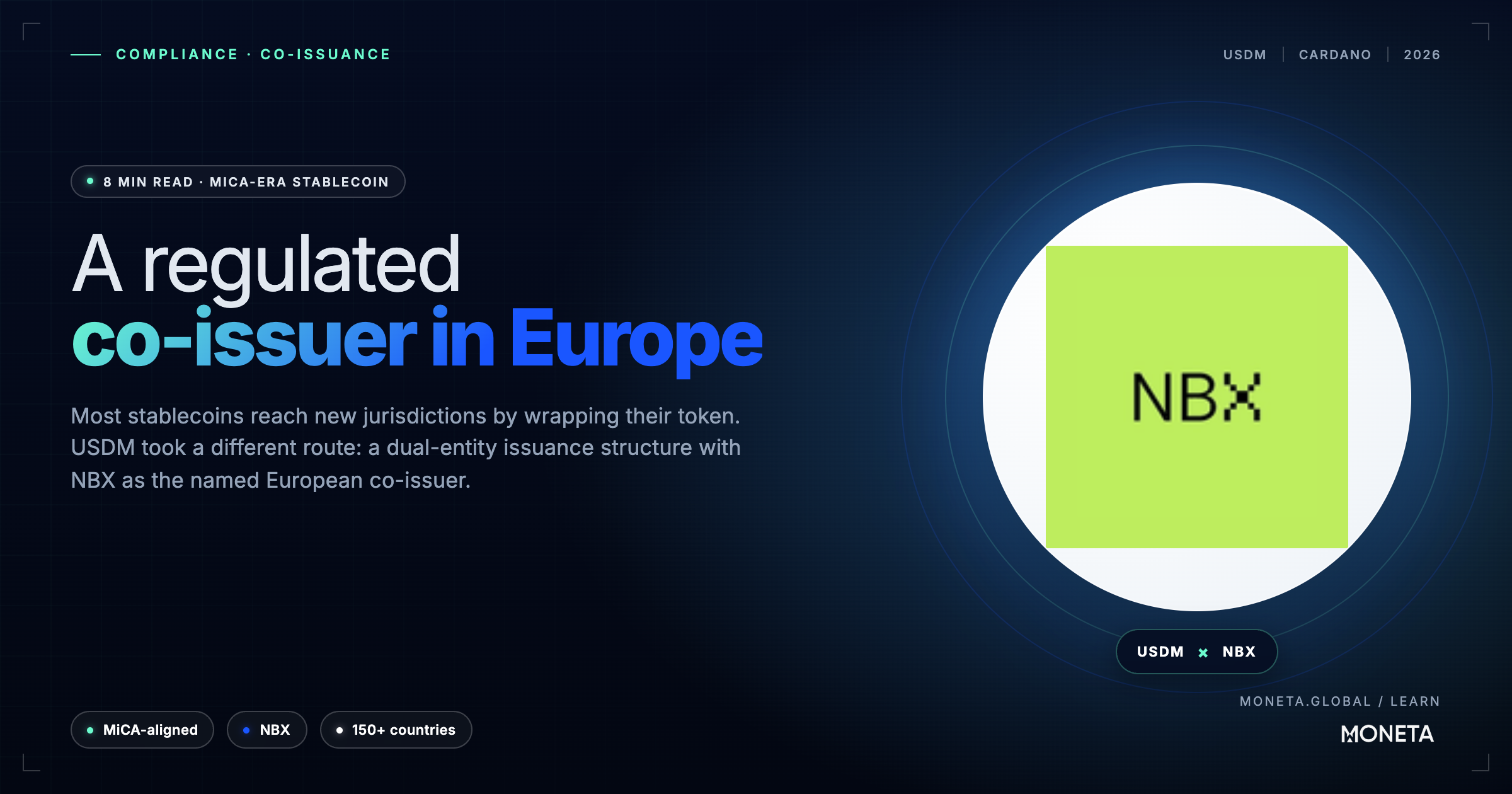
USDM™ took a different route. From the start, the design assumed that a fiat-backed digital dollar serving global users could not be issued out of a single jurisdiction without compromising either compliance or reach. The answer was a co-issuer structure: Moneta Digital, a U.S.-registered Money Services Business, paired with the Norwegian Block Exchange (NBX) as the regulated European counterparty.
That decision is the reason USDM is legally accessible across the European Union and 150+ additional countries today, without resorting to wrap-and-bridge workarounds. This article explains what co-issuance actually means, why it matters in a MiCA-era market, and what it unlocks for the institutions and builders integrating USDM.
What does "co-issuer" actually mean?
In stablecoin terms, a co-issuer is a separately licensed legal entity, in a different jurisdiction, that has its own authority to mint and redeem the same token under its own regulatory regime.
That is structurally different from how most stablecoins handle international users. The common pattern is:
- The token is issued by one legal entity in one jurisdiction.
- For other regions, the issuer relies on local exchanges, bridges, or off-ramp partners to give end users access.
- The regulatory perimeter of the issuer does not extend to those other regions; users abroad are essentially using a foreign-issued asset through a local intermediary.
A co-issuer model collapses that gap. Instead of routing European users through a U.S.-issued asset and a foreign exchange, USDM is issued into Europe by a regulated European entity. Moneta Digital is the issuer in the United States. NBX is the co-issuer for the European Union and the broader 150+ country footprint.
The token itself remains a single, fungible Cardano-native asset. The legal architecture behind it is what changes, and the legal architecture is what determines whether banks, regulators, and institutions can actually use it.
Why is this the right structure for a MiCA-era market?
The European Union's Markets in Crypto-Assets regulation (MiCA) reset the rules for how stablecoins can be offered, marketed, and used across the bloc. Under MiCA, the question is no longer "is this token compliant somewhere in the world?" It is "is the entity offering this token authorized to do so in the European Union?"
A pure U.S.-issued stablecoin cannot answer that question simply by listing on a European exchange. The issuer's regulatory status sits outside the EU's perimeter. Bridging or wrapping the asset doesn't change that. It just adds a custodial layer.
USDM's co-issuance model addresses the question directly. NBX is a Norwegian-licensed cryptocurrency exchange, regulated under national crypto-asset rules, headquartered in Oslo. As USDM's named co-issuer, NBX is the regulated counterparty that allows European users to legally onboard, mint, and redeem USDM under a European regulatory framework rather than a foreign one.
The short version: USDM is not a U.S. stablecoin being shipped abroad. It is a dual-issued asset, with a regulated U.S. entity (Moneta Digital, FinCEN-registered MSB) and a regulated European entity (NBX, Norwegian-licensed exchange). The same token, issued legally on both sides of the Atlantic. That is the structure that gives USDM access to the EU and 150+ countries without a bridge.
How does this differ from the "wrap and bridge" approach?
Most stablecoin expansions outside their home jurisdiction follow a pattern that is now familiar to anyone watching the space:
- The native token lives on its primary chain or jurisdiction.
- A bridge contract locks the token and mints a wrapped version on another chain or in another market.
- Local exchanges and apps trade the wrapped version, and users assume parity.
That model has costs that are increasingly visible. Bridges introduce custodial risk and smart-contract risk. The wrapped asset's legal status is often ambiguous; it is not the same instrument the original issuer is licensed to issue. Recovery in stress events depends on whichever bridge operator is in the middle. And from a regulator's perspective, the user holding the wrapped asset is not actually holding what the issuer's license covers.
The co-issuer route avoids each of those costs:
- No bridge in the middle. USDM is a Cardano-native asset, not a wrapped representation of a token issued elsewhere.
- No legal ambiguity. The token a European user holds is the token an authorized European co-issuer is licensed to mint and redeem.
- No reliance on a third-party custodian to make whole. Redemption flows through licensed entities under their respective regulatory regimes.
- Single asset, single supply. Because both issuers mint the same on-chain token (subject to the same on-chain reserve attestation), there is no fragmentation of liquidity between a "U.S. version" and a "European version."
The result is a stablecoin that behaves like one asset on-chain while remaining legally clean across two distinct regulatory regimes.
What does this unlock for institutions?
For an institution evaluating USDM as treasury, collateral, or a settlement asset, the co-issuer structure changes the conversation in three concrete ways.
1. A clear answer to "who is your counterparty here?" European institutions need to know which entity issues the asset they are holding, and under which license. With USDM, the answer is direct: a Norwegian-regulated exchange, headquartered in Oslo, owned by a long-established Norwegian conglomerate. Not a foreign issuer accessed through a wrapper.
2. Legal access in 150+ countries without bespoke structuring. Many global institutions operate across multiple jurisdictions and need a single instrument that travels with them. USDM launched on Cardano mainnet in March 2024 (US institutional), with NBX co-issuance for the European market following in 2024 under the MiCA framework. Through that co-issuer relationship USDM is now legally accessible across the EU and more than 150 additional countries. For multinational treasuries, that means one stablecoin instead of a patchwork.
3. A compatible regulatory story on both sides of the Atlantic. The U.S. perimeter is held by Moneta Digital, FinCEN-registered, with Money Transmitter Licenses across U.S. states. The European perimeter is held by NBX. Each side stands on its own regulatory footing. Neither depends on a wrapper or a bridge to be "compliant elsewhere."
What does this unlock for builders?
For developers building Cardano-native applications, the co-issuer structure shows up in a quieter way: it widens the legitimate user base that can hold and transact your dApp's stablecoin without legal friction.
A protocol that integrates USDM is, by extension, integrating an asset that European users and counterparties can lawfully hold under a regulated European issuance regime. That is meaningful for:
- NFT marketplaces pricing in USD and selling to international collectors.
- Lending and DEX protocols sourcing liquidity from European-domiciled treasuries.
- Payment and remittance flows that need to settle into a stable asset on both sides of a corridor.
- DAO treasuries holding stable reserves that can be deployed cross-border.
Composability isn't only a technical property. It's also a regulatory one. A stablecoin with a coherent issuance story across jurisdictions is a stablecoin more partners can build on without inheriting a compliance question.
Why is this the unsexy moat?
It is tempting to treat regulatory architecture as the boring layer beneath the interesting product. But in stablecoins, the architecture is the product. A digital dollar is only as useful as the legal framework that lets institutions, exchanges, and users actually hold and move it.
Most of the work behind USDM's co-issuer structure is invisible to the end user. They see one token in their wallet, one mint flow, one redemption path. What they are using underneath is a dual-entity issuance model that took years of licensing, banking, and regulatory engagement to build, and that very few Cardano-native stablecoins can match.
That is the moat. Not the brand. Not the integrations. The fact that the same on-chain asset is legally issuable on both sides of the Atlantic, by separately licensed entities, with reserve attestation enforced on-chain by a decentralized oracle.
What's next
The co-issuer pattern USDM established with NBX is now a reference architecture for what a globally compliant on-chain dollar can look like. It assumes regulators will continue to draw clearer lines around stablecoin issuance, and that the right answer is not to route around those lines, but to issue legitimately on both sides of them.
For builders, the practical takeaway is simpler. The USDM in your dApp's smart contract is the same USDM held by a treasury team in Frankfurt, a creator in Lagos, or a lending protocol in Toronto. It got there without a bridge, and it got there legally. That's what a co-issuer structure actually unlocks.